


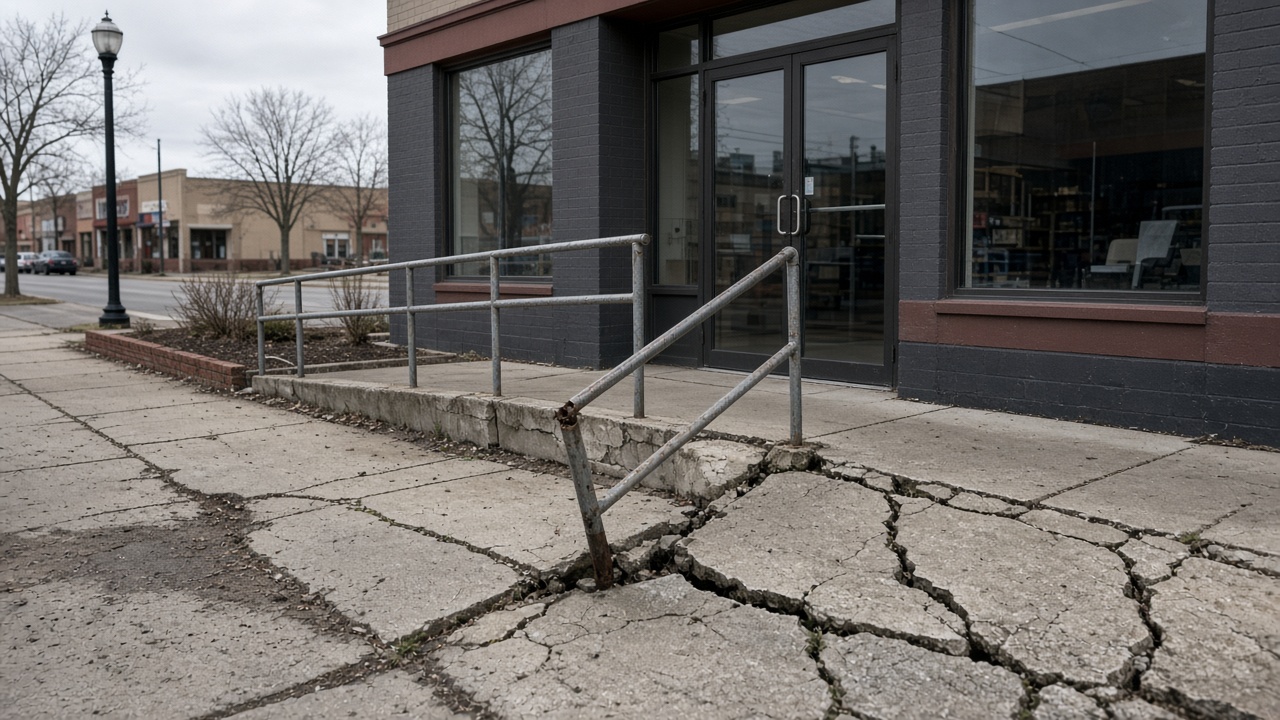







A New York appellate court has ruled on a personal injury case involving Christine Laubis and the County of Nassau. The court's decision affects how liability is determined for injuries that occur on public sidewalks. This ruling is significant for individuals who may seek damages after accidents on municipal property.
The case, Laubis v. County of Nassau, was filed after Laubis allegedly tripped and fell on a raised sidewalk flag in East Meadow on April 2, 2020. Following the incident, she filed a lawsuit against several parties, including the County of Nassau, the Town of Hempstead, and the Kearns defendants, which are Leo F. Kearns, Inc., and Leo F. Kearns Funeral Directors, Inc. The lawsuit aimed to recover damages for her injuries.
The dispute centers around whether the County of Nassau and the other defendants could be held liable for the alleged defective sidewalk condition. The case reached the Appellate Division of the Supreme Court of the State of New York after the Supreme Court, Nassau County, issued a ruling on April 3, 2023. In that ruling, the court denied the County's motion for summary judgment while granting similar motions from the Town of Hempstead and the Kearns defendants.
In its recent decision, the appellate court affirmed parts of the lower court's ruling while reversing the denial of the County's motion for summary judgment. The court found that the County of Nassau had established that it did not receive prior written notice of the alleged sidewalk defect, which is a requirement under local law for municipalities. The court stated, "The County established, prima facie, that it did not receive prior written notice of the alleged defect..." This means that the County was not liable for Laubis's injuries.
The court also addressed the Kearns defendants and the Town of Hempstead, ruling that they were not liable either. The Kearns defendants demonstrated that they did not create the defective condition and had no special use of the sidewalk. Similarly, the Town of Hempstead showed it did not own or maintain the sidewalk. The court noted, "An abutting landowner will be liable to a pedestrian injured by a defect in a public sidewalk only when the owner either created the condition or caused the defect to occur because of a special use..."
This ruling clarifies the responsibilities of municipalities and property owners regarding sidewalk maintenance and liability for injuries. It emphasizes that without prior written notice of a defect, municipalities like the County of Nassau cannot be held liable for accidents. This decision may have broader implications for future personal injury claims involving public sidewalks across New York.
The outcome of this case affects not only Laubis but also sets a precedent for similar cases in the future. Individuals injured on public sidewalks may find it more challenging to claim damages unless they can provide evidence of prior written notice or show that the municipality created the defect. The ruling reinforces the legal barriers that plaintiffs must navigate when seeking compensation for injuries sustained in public spaces.
As for what’s next, the ruling can be appealed to the New York Court of Appeals, which is the state's highest court. However, it is unclear if the parties involved will pursue further legal action. There may also be related cases pending that could further explore the nuances of liability in personal injury claims against municipalities.