




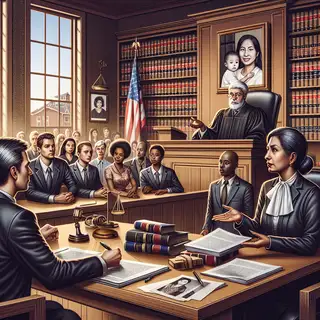






The D.C. Circuit Court has upheld the conviction of Antonio Payne for carrying a pistol without a license (CPWL) and denied his motion to suppress evidence obtained during a search of his home. This ruling, issued on July 31, 2026, affects Payne and sets a precedent regarding the application of the good-faith exception in search warrant cases.
Payne’s case arose after a drive-by shooting targeted his home in Washington, D.C. Officers responding to the incident discovered evidence of multiple crimes, leading to a search warrant for Payne’s residence. The court’s decision highlights the importance of probable cause in obtaining search warrants and the legal standards surrounding the suppression of evidence.
Background
Antonio Payne was the defendant in the case against the United States of America, which served as the plaintiff. The dispute began after a drive-by shooting occurred near Payne's townhouse in the Fort Lincoln neighborhood of Washington, D.C. On April 18, 2022, a 911 dispatcher reported gunshots, and officers arrived to investigate.
During their investigation, officers reviewed security footage from neighbors, which showed Payne holding a firearm during an altercation with an unidentified man. Following this, detectives applied for a search warrant for Payne's home, believing there was probable cause for a CPWL violation. The warrant was granted, and multiple firearms and drugs were later recovered from Payne's residence.
The Ruling
The D.C. Circuit Court, led by Circuit Judge Wilkins, ruled on the appeal filed by Payne, who challenged the denial of his motion to suppress evidence obtained during the search of his home. The court found that the search warrant was supported by probable cause, stating, "Given that officers responded to a shooting, Payne was observed wearing clothing that matched the shooter’s description, and there was footage of someone resembling Payne exiting and re-entering the home holding what appeared to be a gun."
The court also addressed Payne's arguments regarding a typographical error in the warrant application. Although the detective incorrectly listed the applicable D.C. Code, the court maintained that the warrant was valid, emphasizing that the officers acted in good faith when executing the search. The ruling stated, "Even assuming, without deciding, the warrant authorizing the search of Payne’s townhouse was not supported by probable cause, the good-faith exception bars suppression of the evidence obtained in the search because the officers acted in objectively reasonable reliance on the warrant."
Impact
This ruling has significant implications for future cases involving search warrants and the good-faith exception. It reinforces the idea that minor errors in warrant applications, such as typographical mistakes, do not automatically invalidate the warrant if the officers acted in good faith. This decision may influence how lower courts handle similar cases, particularly those involving the suppression of evidence obtained through search warrants.
The ruling also underscores the importance of probable cause in the issuance of search warrants. It clarifies that as long as there is a reasonable basis for the warrant, courts may uphold convictions even when defendants challenge the legitimacy of the evidence obtained during the search.
What's Next
Payne's legal team may consider appealing the decision to a higher court, although details regarding any potential appeal were not available in the court filing. There are currently no related cases pending that directly connect to this ruling.