









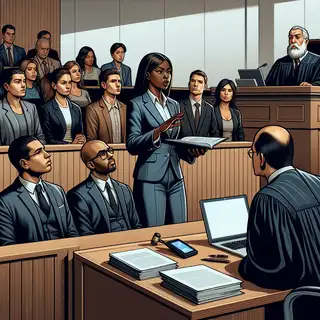


The Ninth Circuit Court of Appeals has ruled on a significant case involving copyright claims against GitHub, Inc. The court decided to uphold the dismissal of a lawsuit brought by several programmers who alleged that GitHub's AI tools, Copilot and Codex, reproduced their code without proper attribution. This ruling is important as it clarifies how the Digital Millennium Copyright Act (DMCA) applies to artificial intelligence technologies and their output.
The case, titled Doe v. GitHub, Inc. (docket number 24-7700), was filed by a group of programmers who claimed that GitHub's AI tools violated their rights under the DMCA. The plaintiffs argued that these tools created new works based on their copyrighted code but failed to include necessary copyright management information (CMI), such as attribution and copyright notices. This ruling affects not only the plaintiffs but also sets a precedent for how similar cases may be handled in the future.
Background
The plaintiffs in this case, identified as J. Doe and others, are programmers who have published open-source code on GitHub. GitHub is a widely used platform for developers to store and share their code. The company, owned by Microsoft, has developed AI tools like Copilot and Codex, which assist programmers by generating code based on user prompts. These tools are trained on vast amounts of publicly available code, including code from GitHub itself.
The dispute arose when the plaintiffs alleged that Copilot and Codex were reproducing their code without proper attribution, violating the DMCA. They claimed that when these AI tools generated code, they sometimes produced outputs that were nearly identical to their original works, but without including the required CMI. The case was initially brought in the Northern District of California, where the district court dismissed the DMCA claims, leading to the appeal to the Ninth Circuit.
The Ruling
The Ninth Circuit panel affirmed the district court's decision to dismiss the DMCA claims, agreeing that the plaintiffs did not adequately state a claim under the law. The court noted that the plaintiffs had standing to bring their claim, as they alleged a substantial risk of injury. However, the court found that the AI tools did not violate the DMCA because they did not “remove or alter” CMI from existing works. Instead, the court stated that Copilot and Codex create new works that do not contain the CMI in question.
The court ruled, "Copilot and Codex do not 'remove or alter' copyright management information from a copy of an existing protected work but instead create new works that never contained that information."
The ruling emphasized that the DMCA's provisions regarding CMI apply to existing works from which information is removed or altered. The court clarified that merely producing a new work that is similar to existing code does not constitute a violation of the DMCA. The judges involved in this decision were Circuit Judges Sidney R. Thomas and Eric D. Miller, along with District Judge Stanley Blumenfeld, Jr.
Impact
This ruling has significant implications for the tech industry, particularly for companies developing AI tools that utilize large datasets of existing works. By affirming that AI-generated outputs do not infringe upon copyright laws in the same way as traditional copying, the court has established a clearer legal framework for the use of AI in programming and software development.
The decision may encourage further innovation in AI technologies, as developers now have greater assurance that their tools can operate without infringing on existing copyrights. However, it also raises questions about the protections available to original creators of code, especially in the context of open-source licensing. The ruling does not address the potential for copyright infringement claims, which remain a separate legal issue.
What's Next
The plaintiffs may consider appealing this decision to a higher court, but details on any potential appeal were not available in the court filing. Meanwhile, the case leaves open the possibility for future litigation regarding the input theory of DMCA liability, which the court declined to address due to forfeiture by the plaintiffs.