







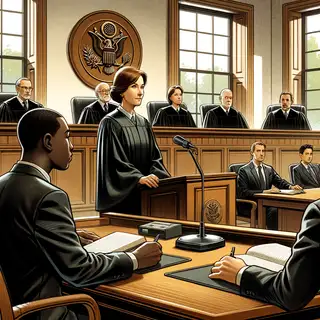




A District Court in Washington, D.C., has recommended the revocation of Eric Thomas's probation after he failed to follow the terms of his supervised release. This decision affects Thomas, who has struggled with compliance in treatment programs. The ruling is important as it highlights the challenges individuals face in rehabilitation and the consequences of failing to meet probation requirements.
The case, officially titled United States v. Thomas, was filed under Criminal No. 2017-0061. The proceedings began when the U.S. Probation Office filed a petition on October 18, 2024, requesting a warrant for Thomas's arrest due to his failure to report to the probation office upon his release from custody. This failure was categorized as a Grade C violation, which is a less severe breach of probation terms. Judge Cooper issued a warrant on November 14, 2024, leading to Thomas's subsequent hearings.
During the hearings, Thomas appeared before Magistrate Judge Zia M. Faruqui. Initially, he was released after a detention hearing on February 10, 2025. However, Judge Cooper later referred the final hearing on the violation to Judge Faruqui. Since then, several reentry progress hearings have been held to assess Thomas's compliance with the terms of his probation.
Throughout this process, Thomas experienced mixed success. He successfully completed an intensive inpatient treatment program but struggled with subsequent phases. He was arrested for leaving the treatment facility, which he admitted was a mistake. Following this, he attempted a second treatment program but faced similar challenges. In total, he spent about 28 days in custody related to the pending petition.
On January 16, 2026, a hearing was held where Thomas admitted to the Grade C violation. Both the U.S. Probation Office and the U.S. Attorney’s Office recommended that the court revoke his supervised release and sentence him to time served, with no additional period of supervision. This recommendation was based on several factors, including the fact that Thomas's supervision was set to expire on September 29, 2026, and that he had no new law violations. The parties agreed that further treatment programs were unlikely to be successful.
In the court's report and recommendation, Judge Faruqui stated, "The Court recommends finding that the Defendant violated his conditions of release as stated in the outstanding petition, that the Defendant’s supervision should be revoked, and that the Court impose a sentence of time served with no additional period of supervision." This ruling indicates a consensus among the parties involved regarding the necessity of revoking Thomas's probation.
The impact of this ruling could be significant for Thomas and others in similar situations. It underscores the importance of adhering to the conditions of probation and the potential consequences of failing to do so. For individuals like Thomas, who are trying to reintegrate into society, the challenges of completing treatment programs can be daunting. This case may also serve as a cautionary tale for those on probation about the importance of compliance.
Looking ahead, Thomas's case may not be over. While the court has recommended revocation of his probation, there is a possibility that he could appeal the decision. However, details about any potential appeal or related cases were not available in the court filing. The outcome of this case could influence how similar cases are handled in the future, especially regarding the balance between rehabilitation efforts and the enforcement of probation terms.